Wednesday, January 1, 2014

Dainik Bhaskar Confers Guru Siksha Samman to Vikas Kumar

Dainik Bhakar in a program organized in Xaivers School among othersHoliday Home conferred Guru Siksha Samman Award 2013 to Vikas Kumar, Career Counsellor & Psychologist, Psychographic Society, Ranchi. along with other dignitaries. it was given to leading personalities in education which included eminent principals and scholars of different fieds.Other Prominent Persons to recieve the award were Mr J. Mohanty, Principal, DPS Ranchi, Mr A. K. Singh, Principal, JVM-Shyamli, Mr Rajan Vergheses, Principal, Kairali School among others.


Vikas Kumar recieving the award


Mr J Mohanty, Principal, DPS, Ranchi recieving the award


Mr D K Tiwary, Secretary, Educatioin and Mr Kuldeep Vyas, Chief Editor, Dainik Bhaskar


Mr A K Singh, Principal, JVM Shyamli recieving the award


Mr Sujeet Kumar, Academic Director, Sri Chaitanya Receiving the award


Mr Paras Agarwal, Director, Brothers Academy recieving the award
 

An uncommon life of Delhi CM Arvind Kejriwal

Source: India Today: 1st January, 2014
   
In the wintry lanes of Bara Mohalla in Hisar, Haryana, a few of the older bystanders still remember the day Gita Devi and Govind Ram were blessed with the arrival of their first-born. Which Govind Ram, they first ask, before answering with a sly rhetorical question that tells you they know why you're here: "Woh Jindal colony wale? (The one from Jindal colony?)" The boy was born on Janmashtami on August 16, 1968. His grandparents had decided to call him Krishna. Now, 45 years later, the world knows him as Arvind Kejriwal, chief minister of Delhi and architect of a hitherto unthinkable political revolution that does not derive its power from religion, caste, class or cadre.

The Kejriwals lived on the outskirts of Hisar in a colony meant for employees of Jindal Strips where his father worked as an electrical engineer. Their house was a simple, cluttered quarter. The only vehicle the family owned was a scooter.

Kejriwal says he only has a foggy recollection of his childhood. But cousins who spent lazy summer vacations with him and classmates at Hisar's Campus School, where he went after studying in English-medium missionary institutions in Sonepat and Ghaziabad, distinctly remember his attributes and idiosyncrasies. Kejriwal was often found sitting quietly in the classroom, a frail boy with a scrubbed-clean face and thickly combed hair. He was not outdoorsy, preferring chess and books to cricket and football. He was handy with a pencil and sketchbook though, and until he was about 11, could draw anything he saw: Trees, buildings, animals, the objects in a room.

With his cousins-there would be nine or ten of them running around his maternal home in Bara Mohalla every summer holidays-he was just one of the members of the merry band, rather than the leader of men he now is. Back then, the spiritual boss of the little gang was his cousin Kusum Goyal, now a chartered accountant in Delhi's Paschim Vihar. Their games included the indigenous favourites Oonch Neech and Vish Amrit that were a staple of all middle-class Indian children until the technology boom of the 2000s. "Arvind was neither quiet nor hyperactive, as some children are today," Goyal tells India Today. "We were all mischievous but smart enough not to draw enough attention to get into trouble with the grown-ups."

Kejriwal was raised as a religious child. Regular trips to church at school in Sonepat and Ghaziabad made a deep impact on him. At home, he heard discourses on Hindu moral teachings. He prayed in the morning, before he went to bed at night, and sometimes during the day if he found the time.

Even as a young teenager, he would sometimes display a sense of responsibility and righteousness that took those around him by surprise. Friends speak of an incident when he had been selected to represent his school in a debate but got high fever the night before the competition. No one expected him to turn up the next day but he reached the venue riding pillion on his father's scooter wrapped in blankets, determined to not let the school down. When his younger sister Ranjana took ill the night before a Class VIII exam, unable to study, he stayed up all night reading textbooks to her so she could revise without having to concentrate too hard. Ranjana, 41, a doctor, now lives in Haridwar where she works for bhel. His brother, Manoj, 38, is a software engineer with ibm in Pune.

Among his teachers, Kejriwal best remembers 'Mrs Chopra', who taught biology at Campus School and would sometimes sit with him after class to discuss his future plans. She pushed him into public speaking and cast him in a play when he was in Class X. Kejriwal went on to become the governor of the Hindi drama society in his final year at iit, Kharagpur, and, perhaps more importantly, can now infuse energy into any crowd with his fiery, off-the-cuff speeches.

It was only when he left home as a mechanical engineering student that Kejriwal's political opinions began to take form, along with the emergence of his irregular affinity towards working for those less fortunate than him.

Namit Arora, a batchmate at iit who lived with Kejriwal at the Nehru Hall hostel for four years, describes him as "articulate, self-confident, and with a quiet intensity about himâ?. Another batchmate, George Lobo, who now lives in the US, says that while the rest of them were busy planning careers overseas, Kejriwal would always talk about doing something that would change India.

His early influences were V.P. Singh, whose honesty in the Bofors scam as defence minister and whose efforts for social justice by implementing reservation on the basis of the Mandal Commission report as prime minister inspired a young Kejriwal. Lobo says that Kejriwal was strongly opposed to bjp for the Ram Mandir movement, which culminated in the demolition of the Babri Masjid in Ayodhya in 1992. "He was a bright student with a world of opportunities in front of him. How many of us dedicate our lives to the nation when we have a lucrative career in front of us?" Lobo asks. "I'm making good money here in the US and Arvind was ten times smarter than me."

Kejriwal's family remembers that he returned to Hisar from iit after his final year with just the clothes he was wearing and the residue of the money left from what he had set aside for his return journey. Everything else he owned, he had given to charity.

But the real turning point in his life was when he went to meet Mother Teresa at the Missionaries of Charity in Kolkata after resigning from Tata Steel in Jamshedpur. They wouldn't transfer him to their social work department since he'd been hired as an engineer. "Kolkata is very close to Jamshedpur. I'd heard of Mother Teresa, so I thought I'd go meet her. There was a long queue at the Missionaries of Charity. When my number came, Mother Teresa kissed my hand and I expressed my wish to work with her. It was a divine moment for me. She asked me to go and work at her Kalighat Ashram. I was there for two months," Kejriwal tells India Today.

He appeared for the civil services exam, got selected for Indian Revenue Service (IRS) in his first attempt, and decided to give it another shot because he thought he'd be able to do more for the people as an IAS officer. When he got IRS again on his second attempt, he decided to settle for it. It was during his training at the Lal Bahadur Shastri Academy of Administration in Mussoorie in 1993 that Kejriwal met Sunita, a fellow IRS officer. He got to know her better during the 62-week induction programme for revenue service officers at the National Academy for Direct Taxes in Nagpur. "We admired each other. She's a very shy person, a very decent person. One day, I just knocked on her door and asked her: 'Will you marry me?' And that was it," Kejriwal was quoted as saying in his biography put together by the Ramon Magsaysay Foundation, which gave him an award for Emerging Leadership in 2005. They were married in 1994 before they got their first postings in New Delhi.

Kejriwal and Sunita first moved into a government flat in Kalkaji, where they simply threw a couple of mattresses on the floor to serve as a living room. When they moved to Kaushambi in East Delhi a year later, they bought a cane sofa. It can still be spotted during TV interviews, lying in the drawing room as their most elaborate piece of furniture.

While at the Income Tax Department in Delhi, where he occupied offices at Mayur Bhawan, Vikas Bhawan D Block, and at the main C.R. Building as joint commissioner, Kejriwal was frustrated by how little he was being able to do for people. He started an NGO, Parivartan, with Rs 50,000 donated by his brother Manoj and another Rs 50,000 given by a maternal uncle. They targeted his own IT department, which had no idea that the man putting pressure on them for honest tax assessments and swift reimbursement was their own officer.

But Kejriwal felt his NGO's impact was limited. For how long, for how many days, how many doors would he have to knock to help more people deal with larger problems. "Our hopes rose when Right to Information (RTI) came," says Kejriwal. "But later I felt the RTI was an incomplete tool. What can we do even if get the information if no one gets sent to jail? We felt there is a need to change the way politics is done in our country. We started the Jan Lokpal movement and later formed the Aam Aadmi Party (AAP)." The rest, as they say, is history in the making.

On December 23, when he announced that aap was ready to form the government in Delhi, Kejriwal took a few minutes to meditate before he met his colleagues. He was dressed in his trademark grey trousers, a navy blue sweater, and a muffler wrapped around his neck. He then sat in a blue WagonR, donated to AAP by one of his supporters, to drive to Raj Niwas. The only car his family owns is an old Alto registered in Sunita's name. Their children, daughter Harshita, 17, and son Pulkit, 12, though seemingly unaffected by their father's newfound status, are extremely proud of him. Pulkit had told Mail Today last year that "Papa mein bahut dum hai (Dad has a lot of guts)".

Eight years ago, Kejriwal had been travelling to Jodhpur with his cousin Kusum and her husband Kailash when the conversation veered around their children. Kusum said she was worried about the future of her son and daughter, who are a few years older than Pulkit and Harshita. Kejriwal told her: "Agar tu aur main apne bachchon ki chinta karne lage, toh desh ka kya hoga?" (If people like us, who are fortunate, start worrying about the future of our children, what will happen to the rest of the country?")

It is perhaps this spirit that has taken Kejriwal where he is today: The spearhead of a possible political uprising.

Vikas Kumar with Director IIM-Ranchi

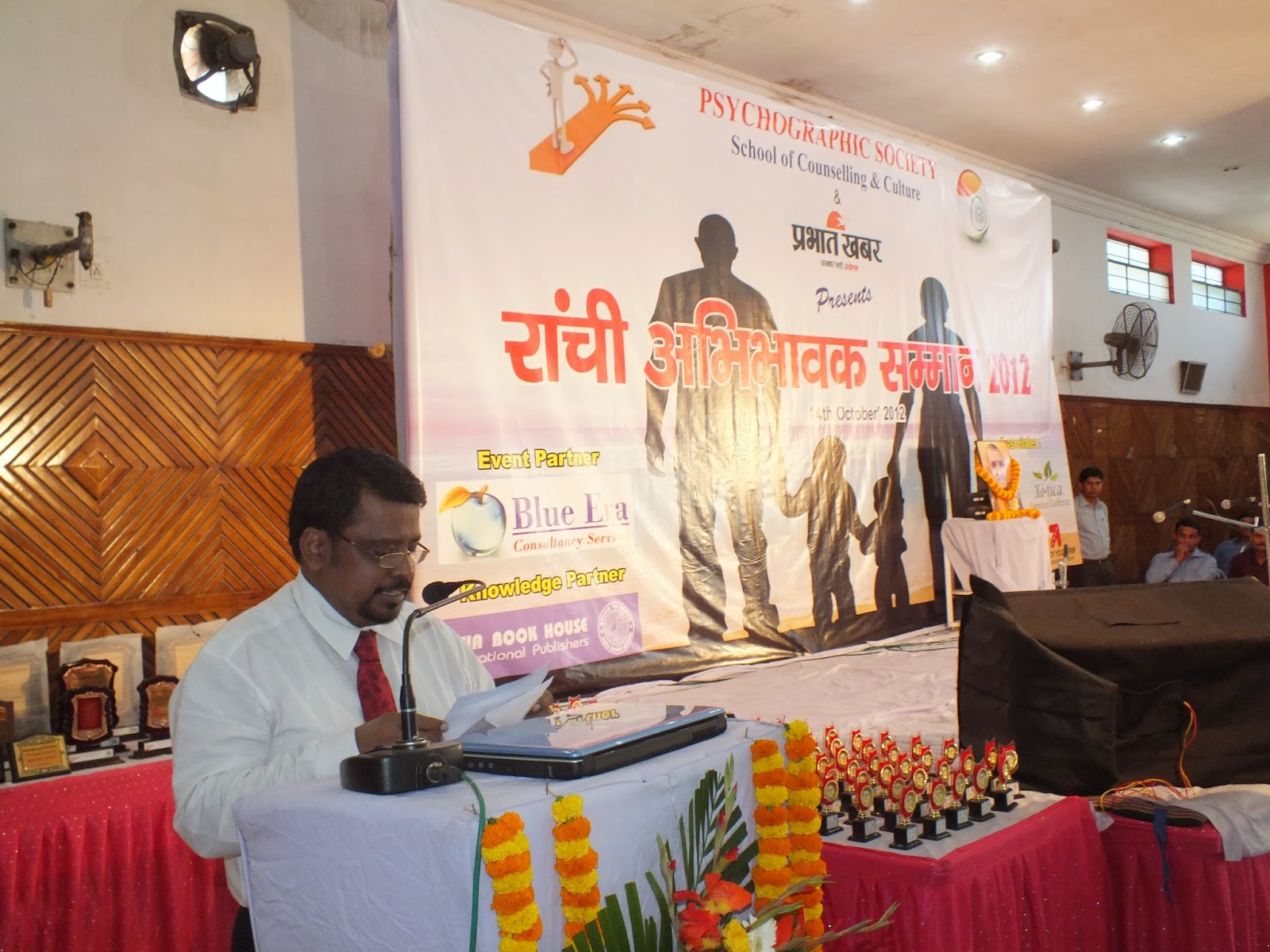
Prof M J Xavier, Director, IIM Ranchi  participated in three different programs of Psychographic Society. First he came for "Ranchi Abhivavak Samman" organized on 14th October, 2012 attended by more than 600 parents to celebrate 9th Foundation day of Psychographic Society.


More than 600 Parents in "Ranchi Abhivavak Samman" organized in association with Prabhat Khabar to feliciate top performing students of Ranchi from different segments


Prof M J Xaiver, Director IIM-Ranchi Addressing parentts


Prof R A Singh, Chairman, Psychographic Society Conferring with "Pride of Ranchi" Award to Prof M J Xavier.


Prof M J Xavier giving "Parent of the Year" Award to Dr Bharti Kashyap. Her son Dr Vibhuti Kashyap was top ranker from Ranchi in PG AIIMS


Add caption

Prof  M J Xavier feicitating parents of meritorious students

 
Prof M J Xaiver  inaugrated Counsellin Centre of Psychographic Society at City Centre, Club Road and thus came into existence Psychographic Society School of Counselling & Culture
 

Prof  M J Xavier inaugurating counselling Centre. Mr M.k.Sinha, Principal, DAV-Kapildev, Ms Tanusri, Faculty IIM, and Vikas Kumar


Mr Sumit Singh, giving bouquet to Prof Xavier


Psychographic Society welcomed him for the last time in the city after he moved on to be Director in VIT. Mr A.K.Singh, Principal, JVM, Shyamli Chaired the Farewell Ceremony
 

Vikas Kumar Giving farewell speech in honour of Prof M J Xavier


Vikas kumar and Prof M J Xavier


Counselling in DPS, Gaya by Vikas Kumar

Vikas Kumar, Career Counsellor & Psychologist conducted sessions for students and parents of DPS, Gaya in 2013. DPS Gaya has also introduced parent counselling in their PTMs.

Vikas Kumar, interacting with parents of DPS, Gaya


Mr Abhishek kumar, Principal,DPS Gaya with Parents


Mr Sanjiv Kumar, Pro Vice Chairman taking feedback after counselling session


Vikas Kumar in prospectus of DPS Gaya

Counselling in Sri Ayyappa Public School, Bokaro by Vikas Kumar

Vikas Kumar, Career Counsellor and Psychlogist Ranchi  Psychographic Society conducted counselling sessions for different classes.in Sri Ayyappa Public School, Bokaro. Dr S. S. Mahapatra, Director, SAPS, conceptualized Counselling sessions on different themes.   for students and Parents. Vikas kumar  conducted more than 8 seminars in 2013 for students of Std 7th to Std 11th for NTSE, Art of concentration, Balancing Board Exam and Competitive Exam, Program was highly appreicated by students and Parents.

Dr S S Mahapatra, Director, SAPS, introducing Vikas Kumar, Psychographic Society. Also in the frame Mr Sumit Kumar, Chief Technical Officer, Psychogrphic Society


Vikas Kumar Addressing Students


Vikas Kumr conduction "Art of Concentration" For junior Section


Mr Venugopal, Former Direcotor,SAPS welcoming Vikas Kumar


Mrs Letha Mohan addressing students and explaining the importance of Counselling Session and appreciating Vikas Kumar


Students and Parents of SAPS hearing with rapt attention


Vikas Kumar Counselling Students


Vikas Kumar is Leading Career Counsellor & Psychologist in Ranchi and Jharkhand. To Know more about him and Organization. log on to
www.psychographicsociety.com.

To take Appointment with Vikas Kumar,call 94709534303

Vikas Kumar with President of India

Vikas Kumar, Career Counsellor and Psychologist, Ranchi who has done masters in Psychology and secured Gold Medal in Yoga Psychology had been associated with Bihar School of Yoga From 1995-2004 as co-founder and Director for Children movement named "Bal Yoga Mitra Mandal" under tutelege of Sw Niranjan.During his tenure 80 thousand children had learnt Yoga across the country. Core philosophy of the organization was "Yoga Education for the children, by the Children".
 
  Vikas Kumar had Proposed to celebrate "Bal Yoga Diwas" on birthday of Swami Niranjanaananda, Parmacharya of Bihar School of Yoga. When President of India Dr A.P.J.Abdul Kalam had visited Bihar School of Munger on 31st May, 2003 Vikas kumar along with members of BYMM had requested President to Visit munger on 14th february, 2004 and join in celebration of Bal Yoga Diwas. Visit culminated due to Swami Niranjan's Leaderhip and Bihar School of Yoga's history.

31st May: 2nd Floor, Ganga Darshan, Munger. Dr APJ Abdul Kalam, President Speaking to Children,. Vikas Kumar in black Kurta. Sw Suryaprakash on left side of President


In order to celebrate Bal Yoga Diwas "Yoga Gyan Pariksha" was conducted in which 16000 chilren participated.. 600 members under 25 Team Leaders, 10 Zone incharges work for the success under co-ordination of Vikas kumar and guidance of Sw Niranjan.Yoga Mitra Mandal gave active co-operation to ensure success.

16000 Children, 500 Teachers and Members of Yoga Mitra mandal attending Bal Yoga Diwas. Entire Crowd Management wihtout Police by members of BYMM


Vikas Kumar, Master of Ceremony, anchoring the program in Presence of President, Sw Niranjan and Governor of Bihar


Swami Niranjanananda, Parmacharya, Bihar School of Yoga, whose blessings made this program a success addresing children


Dr A P J Abdul Kalam, President of India Addressing 16000 children of munger


President interacting with children


President of India and Vikas Kumar on stage

Success of this program was due to 25 Team Leaders,100s of active Incharges and 500 active volunteers.

Kumar  Madhwan
Kumar Vedvrat
Sumit Singh
Ankit Sharma
Chetan Jalan
Gautam Kumar
Sheshnath Rakesh
Pawan Kumar Pathak
Himanshu
Pritam Priyadarshi
Amlesh Krishna
Amir Khan
Satyam
Chandan singh
Kundan Singh
Suprabhat
Md Tipu
Digjvijay Roy
Shwetank S Rahul

Pallavi Prakash
Sandhya Mishra
Tejaswita
Savita Mishra
Mona
Jyotsana Singh
Kshitija
Aishwarya




Sunday, December 29, 2013

OUTLOOK Survey : Top 75 Engineering Institutes in India for 2013

OUTLOOK INDIA Magazine Survey Report 2013 : List of Top 75 Engineering Institutes in India for 2013

OUTLOOK India Survey 2013 : Top 75 Engineering Colleges in IndiaEvery Year Out Look India Will Publish the OUTLOOK India Ranking of Top Engineering Colleges in India 2013 . Out Look India Survey 2013 has Published the New Rankings List of Top Engineering Colleges for the year 2013 .
OUTLOOK India has Published the List of Top Engineering Colleges in India.The Ranking for Top Engineering Institute will be based on the Students Care, Infrastructure, Placements Provided and Academic Excellence.
OUTLOOK Survey Report has Published the Rankings of Top Engineering Colleges, Top Government Engineering Institutes, Top Private Engineering Institutes, Zone Wise Top Engineering Institutes, Top Engineering Institutes in Placements, Top Engineering Institutes in Selection Process, Top Engineering Colleges based on Personality Development, Top Engineering Colleges based on their Academic Excellence, Top Engineering Colleges based on the Infrastructure and Facilities on June 2013.

List of Top 75 Engineering Institutes in India : 

OUTLOOK India Survey 2013 : Top 75 Engineering Colleges in India